

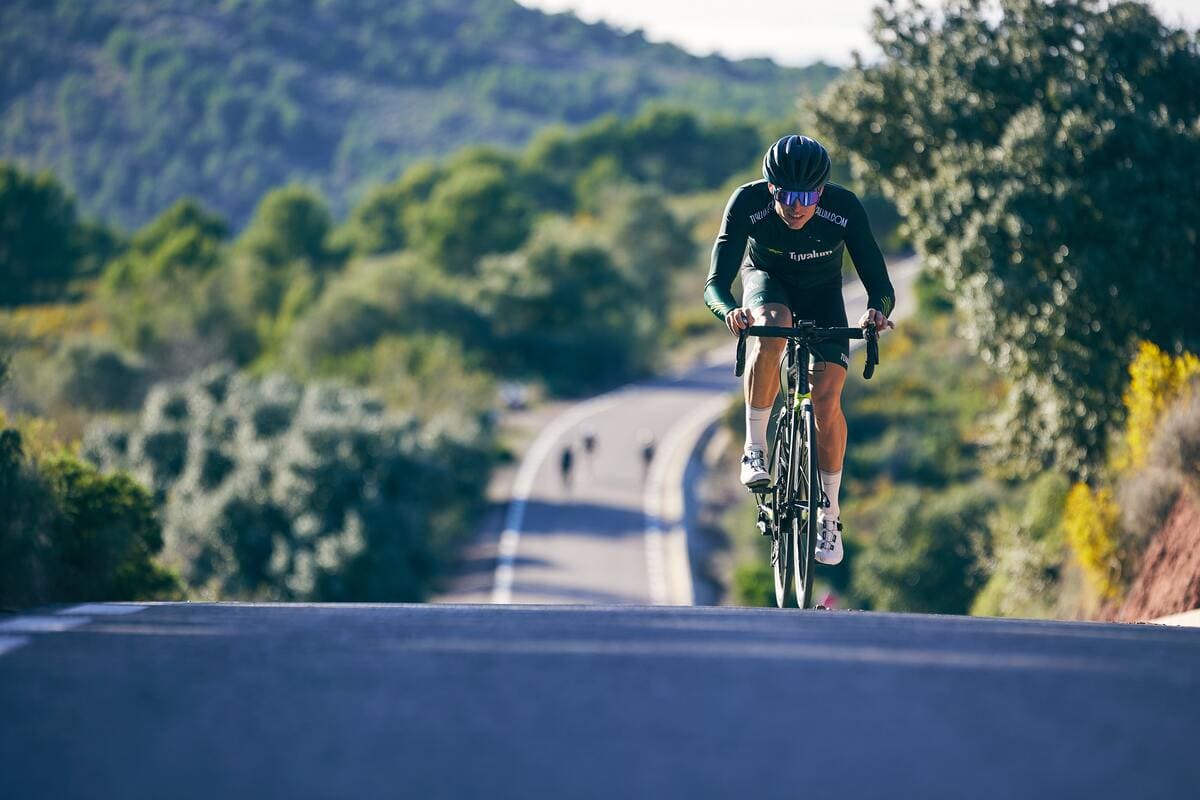
Cyclist legs. Those thick legs, with large thighs and powerful calves attached to a light upper body and a bulletproof heart. Cycling is a physical activity with multiple cardiovascular health benefits and is gaining followers worldwide every day. While improving performance requires optimal physical condition based on muscle volume gain in the legs, which can be worked on the bike, it can be achieved more efficiently through specific strength exercises.
How to gain leg strength for cycling
The human body is an almost perfect machine designed to adapt to the needs of the individual inhabiting it. It works through muscle adaptations to the stimuli it receives, so the more strength physical activity we subject our body to, the greater the muscle gain. The formula for success is complemented, besides performing proper physical activity, by consuming a sufficient amount of protein – between 1.2 and 2 grams per kilogram of body weight – and complete rest – between 7 and 8 hours of sleep daily.
Stronger legs with these exercises
Here is a list of the best strength exercises for the legs:
Jump squat
The combination of strength and cardio is excellent for improving cycling performance, and the jump squat provides it. It involves performing a classic squat, with feet pointing forward, parallel, and the back straight – it is important to avoid curvature. Once completed, it should be followed by an explosive jump upwards, reaching straight legs and fully extended knees. As always, repetitions and sets depend on each person’s level.
Step up or box step-up
We raise the level a bit. The step up or box step-up is an exercise to work the quadriceps, hamstrings, calves, and hip flexor muscles, but it also involves the abdominals and glutes. Place a bench, box, or stable chair at knee height, step up with one leg until the knee is extended, and then lower steadily. First with one leg, then the other.
Lateral lunge
The lateral lunge is a very complete exercise to tone the glutes, quadriceps, hamstrings, and calves, as well as the adductors and abductors. The technique is as follows: stand with feet aligned with the hips and hands on the waist – placing elbows back increases stability. Then, move one leg to its natural side while keeping the other leg straight. Hold for three seconds and return to the starting position. Repeat as many times as possible, then switch legs.
Glute bridge
To finish working the glutes, the most powerful muscle in the body with the greatest force-generating capacity, the glute bridge is a very effective exercise. Bend the knees with calves down and heels aligned with the hips, then explosively and controlledly lift the hips, holding for about three seconds at the top and controlling the descent. Weight can be added to progress the exercise.
Heel raises
To train the calves, heel raises are an ideal option. In this case, only a small, stable, and sturdy support is needed, such as a thick book or wooden pallet, placed under the toes. Once on the front part of the feet, rise onto the toes and lower, always keeping the heels suspended. The range of repetitions and number of sets depends on each person’s fitness level.
Heavy pedaling on a stationary bike
Finally, to transfer muscle and strength gains to the activity that concerns us, cycling, we can work with high resistance on a stationary bike. Ideally, perform two or three sets of about 20 minutes with a low pedaling cadence and demanding resistance, followed by active rest of 5 to 10 minutes with light pedaling.
Essentials for a cyclist’s recovery
After an intense and demanding bike workout, the legs will suffer significant wear and muscle fibers will break, causing pain or soreness. Therefore, carrying out a plan to accelerate muscle recovery is vital, as it allows continuing physical activity in the following days. Otherwise, progress on the bike can be hindered. For this reason, there are specific muscle recovery plans for cyclists.
Working within the metabolic window
The recovery period begins with the last pedal stroke, when the metabolic window starts – the period after training (about 2 hours) during which the body focuses on nutrient assimilation. During this time, consuming quality proteins, carbohydrates, and minerals helps rebuild fibers and recover faster.
Active recovery
Every cycling enthusiast knows that the athletes we idolize get on the stationary bike right after finishing a stage, no matter how demanding it was. Active recovery should not exceed an hour and a half, and heart rate should stay below 65% of maximum capacity. The optimal cadence should range between 90 and 100 revolutions per minute.
Ice baths
Cold provides great benefits for circulation, as it promotes blood vessel dilation and acts as a natural painkiller. Thus, filling the bathtub with ice or cold water will aid muscle recovery in the legs.
Massages
Another option that never fails is massaging the muscles to be recovered, preferably by a professional masseur or physiotherapist. This massage helps eliminate leg stiffness and mobilize fluids that accumulate after physical activity.
Stretching
No matter how many advanced techniques we seek or professionals we consult, the athlete’s greatest ally is stretching. However, its benefits can become drawbacks if done at the wrong time or too intensely. Stretching should be done several minutes or even hours after finishing exercise and gently. A recommendation is to stretch after showering post-workout.
Share:
How to Do Lymphatic Drainage at Home
How to Improve in Cycling: Road or Mountain