

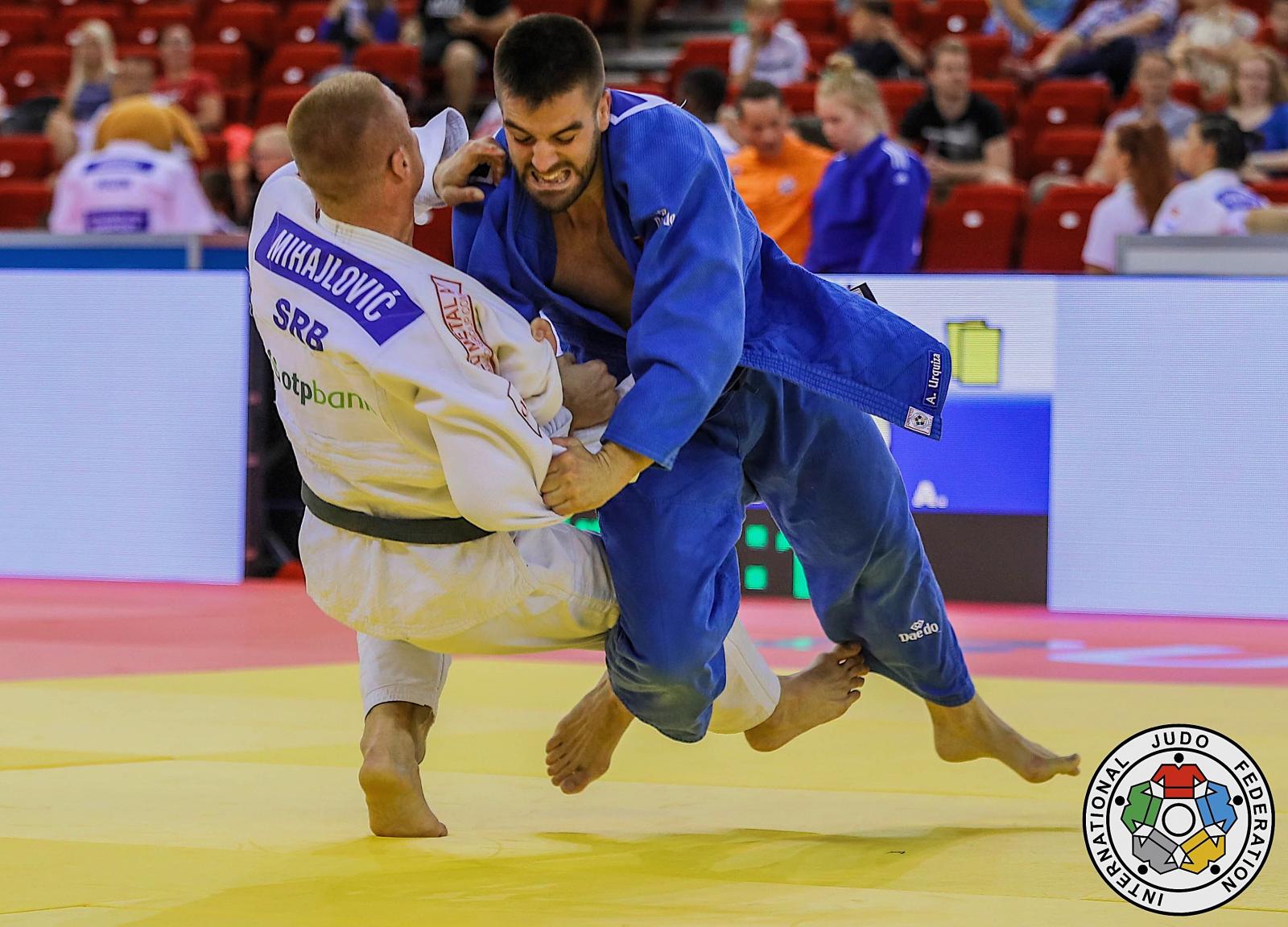
Judo is an individual sport, considered a martial art in which one competes against an opponent with the purpose of throwing them down, aiming at the initiation and learning of self-defense techniques and movements.
“Judo builds people”
Much more than a sport, “Judo builds people”; institutions such as UNESCO, the UN (United Nations), and UNICEF have included judo in several of their cooperation and development programs. Judo is one of the most suitable sports from childhood, as it not only promotes physical and mental well-being but also develops great educational values in those who practice it.

Judo was codified from the beginning for this purpose by its creator, the Japanese educator and first Asian member of the IOC, Jigoro Kano.
- It highlights ethical components: respect for rules, people, and practice locations.
- It promotes camaraderie, discipline, and perseverance.
- It develops a culture that favors self-control and mastery defined within a human environment and a code of conduct.
- The mutual respect generated by physical challenge, acceptance of the confrontation’s outcome (rejecting cheating or winning at any cost), and the development of analytical and adaptive skills make judo significantly contribute to building the individual and social personality of the student.
- It strongly contributes to learning the basic principles of citizenship.
- Development of motor skills, improvement of motor control and performance.
- Enhancement of perceptual-cognitive and sensorimotor mechanisms.
“Through the practice of judo, one shows consideration for their opponent, and also learns to fully understand their point of view. Precisely the development of these qualities is what brings quality people to society, the ultimate goal of judo. It also provides physical and mental strength that prepares us to face any problem or challenge in life with greater chances of success” (Y. Yamashita, 2012)
In 1964 Judo was admitted as an Olympic sport
At the 1964 Olympics, Judo was admitted as an Olympic sport, becoming the first martial art introduced in the Olympics. Today, it is practiced by millions worldwide, not only for effective self-defense training but also for the values and discipline that foster personal growth in practitioners.

Judo allows Judokas to test their skills both at amateur and professional levels, generating seven different divisions by gender divided by the participant’s age.
Almost three and a half million Spaniards are registered in some sport, so it can be said that Spain has a strong sports culture. According to official sources from the Higher Sports Council, Judo is the sixth most popular sport in Spain by number of licenses.
This leads to the conclusion that Judo is not a minority sport but rather one with little media coverage. More than one hundred thousand people in Spain practice this sport, so perhaps the problem is its lack of appeal to the media.
Judo is not only a popular Olympic sport; its philosophy goes beyond mere competition. Judo is a school of life, a way to face existence.
There can be no physical effort without character, willpower, or intelligence.
Judo, through physical contact, establishes a close relationship between people, helps self-knowledge and understanding of others, and is a school of sociability for everyone, regardless of age, gender, or reason for practicing. The longer an individual stays involved, the more positive the effect of judo will be.
Alfonso Urquiza is the Spanish champion in the 81kg weight class and a candidate to participate in the Tokyo 2020 Olympic Games. He is also an ambassador and user of the Sizen 6+.
Share:
Who is pressotherapy intended for?
Running interval training